Saturday, July 30, 2016

Premature Reversal of musclerelaxation leads to complecation


A female patient  60 years of age  was posted for Lap Cholecystectomy.

On evaluation  the patient had GI problem 2 weeks back with acute cholecystitis, distention , vomiting etc for which she was treated conservatively and was seent back home with advice for early surgery of Gall bladder.


            She was slightly plum with big tummy weighing 68kg. No h/o HTN, but DM type II with blood sugar at 130 mg% was given glucose  and 5 units of Insulin. Her Hb was 11.2gm% TLC 12400, Amylase, LFT, Urea and creatinine , Sodium and Pottasium were within normal limits. During PAC she had more complain about back ache and sciatica type pain than Gall bladder discomfort or pain. Her ECG and cardiac  reserve appeared to be OK clinically with good air entry to both lungs.

            She was given an Injection Diclofenac aqua before surgery so that sciatica pain will diminish and her anxiety will be resolved. She was premedicated  with Midazolam 3 mg. Nalbuphine 20 mg  after 10 mins induced withPropofol 100 mg and intubated with ease with 7.5 mmET tube after succynyl chiline injection of 100mg. Connected to ventilator with low tidal volume of 375mg and resp rate of 20 /min . Injection of Vecuronium initially 3 mg . As a routine pre incision procedure takes about 15 mins  so another 2mg Vecuronium was added at this time a total of 5mg. And Halothane 0.8 % was added. To the FGFlow mixture of O2 nd N2O going at 1.5l to 3.0 L/min

The procedure was uneventful with minimal fluctuation of  Vital parameters of HR, BP, and SpO2. The skin to skin procedure lasted 22 mins. As displayed on the timer clock on the wall of the OT.

As the surgery was over so soon we were waiting for the muscle elaxant to wear off. With O2 and N2O mixture running at 50:50. There was no respiratory effort till next 15 mins. We tried to stimulate the resp with under ventilation and accumulation of CO2 to some extent but not more tham 50 mmHg as shown in ETCO2  monitor. There was no CO2 in expired gas.

At this stage the surgeon wanted to take up another case and finish his OT list and  go to OPD.  But all my effort to stop N2O and stop ventilation for  sometime did not help. With much hesitation half of the mixture of Prostigmine 2.5mg and atropine1.2 mg ( diluted to 10 ml) was given IV. Slowly. In next 5 mins there was a flicker of resp movement in Bag and small CO2 curve appeared and being encouraged with that the rest of the mixture was injected. By this time the next patient was standing by the OT for spinal anaesthesia . More movement of resp  was noticed but still with a high expired CO2 of 60mm. But the coughed on the tube and there was fall in Spo2 even with 100 % oxygen. So the patient was extubated assuming that her respiration will be quiet and will improve over next 5-10 mins. As soon as she was extubated the patient was shifted to trolley and taken to Recovery room to accommodate the next surgical case.

In the recovery room the patients breathing appeared to be inadequate with SpO2 less than 90%. An air way was given respiration was watched . It was found that the patient was showing signs  of incomplete reversal with jerky muscular  movement of limbs and inadequate respiratory movement. A second dose of Neostigmine atropine mixture was given IV . Still there was no improvement. The big abdomen  caused more embarrassment to respiratory function. It was intermittently supported with Ambu bag and mask ventilation. When ever there was some fall in Spo2 a little ambu bagging helped to regain Spo2 to 100 %. In the process it was suspected that there is a stomach is inflated with air and we tried to remove  the air introducuing a feeding tube  and were not sure how much was removed. The presence of feeding tube made the bag mask ventilation difficult and therefore the patient was intubated with a 7.5 mm tube on the recovery trolley as such with out any drug or additional muscle relaxant. As such she resisted a little and intubation was completed with ease .

As we tried several times with a T –piece connection  to maintain resp ,But the respiratory drive  and ventilation did not improve  more Ambu bagging support was needed to main Oxygen saturation and avoid CO2 retention and sweating.  Some secretion appeared in the Et tube at this time it was felt probably the patient has aspirated with some Gastric content during  Ambu and mask ventilation. So the patient was shifted to ICU for full and controlled ventilation.

The patient was initially put on Pressure control with SIMV FiO2  0.5 Pr 20cm Peep of 5 and SIMV rate of 12. IE ratio of 1:2 but spO2 was still low and Ambu ventilation showed better SpO2. So the setting was changed to  Pure pressure control Pr of 20cmH2O PEEP of 10 . f=15 I;E ratio of 1:1.5 FiO2 =0.6.  Over the next 15-20 mins patient was stabilized for SpO2, HR. BP was low because of high Intrathoracic pressure and a rapid fluid and a small dose of nor adrenaline helped.   A small dose of Lasix. Change of Antibiotics  wasdone. By next 4 hrs  the pt was better with  stable vitals and patient looking up. Gradually Fi)2, PEEP and Pressure was reduced after overnight ventilation the patient was extubated  and transferred to Ward with out any hassle.

Analysis:

            1. Fundamentally  the process of reversal should have been initiated after some respiratory activity is seen.

            2. The patient should not have been extubated just because started bucking on the tube.

            3. Re intubation should have been planned earlier

            4. What ever way one ventilate with Ambu bag and mask. There is always chance of air going to stomach.

            5. Chance of Aspiration regurgitation  is highest during this period and can not be ruled out.

            6. Persistent Hypoxic episode  could lead to pulmonary edema.

            7. In this case development of pulm edema could be either of the factors as mentioned above.

Lady who suffered
 

Unusual Cardiac complication in a case of Diagnostic Hystero Laparoscopy.

Unusual Cardiac complication:

                        NM 28 yrs olf female patient was presented for Diagnostic and Therapeutic Hystero Laparoscopy under General Anaesthesia for primary infertility and  possible tubal block. 
A preoperative evaluation revealed that she was having RBBB and Left Anerior hemiblock ( Bifacicular block). a 2D Echo cardiography by the cardiologist no other problem with Good LV function and a mild Diastolic dysfunction. She was healthy . Blood reports including Sodium and Pottasium was normal. Airway Normal, She was planned GA with LMA/iGEl intubation. with Scholine  and Non depolarising muscle relaxant to be added if the procedure is prolonged


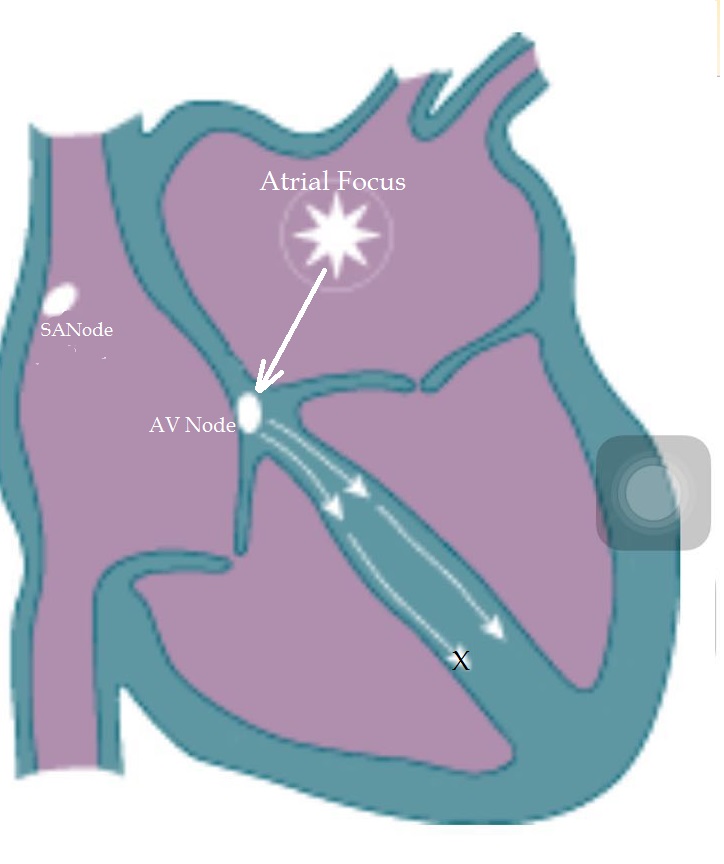
She was induced with Midazolam 2 mg, Nalbuphoine 15 mg followed by  propofol 100mg and Sucynyl choline100mg  and was intubated with a size 3 iGEL  and was ventilated She was monitored with EKG, SpO2, NIBP, EtCO2. Simultaneously Hysteroscopy and CO2 inflation was done and 10 mins through the procedure without any apparent  defect the surgeon was about finishing  when we noticed suddenly the Cardiac rate jumping to 192 / min. At that stage the complexes  looked like VT  but on close observation it was felt that there is clear ventricular complex and regular rhythm. Diagnosis of Supra ventricular Tachycardia ( SVT ) was done. A carotid sinus massage yielded no result.  A 120 mg of Xylocard was pushed after which  the heart rate  dropped to below 165/min but was not sustained. ( See picture )


 Her blood pressure was 140/90, Radial pulse was feeble but palpable. In the meantime surgical procedure was over CO2 removed . But the tachycardia continued. An injection of Ameodarone 150 mg started in a syringe pump as a loading dose. The heart rate came down to 160-170 / min with stable blood presuure. In the mean time the patient recovered from Anaesthesia . and we decided to shift to HDU and continue therapy and monitor the pt closely . Injection of Ameodarone loading dose  had no effect. Thinking it might cause a precipitation of block the dose was reduced for sometime.Addition of some more Xylocard brought down Heart rate to 140 but reverted back to 160-170
By this time pt was fully awake and did not seem to have any discomfort or complain. We also consulted the  Cardiologist who  advised to continue Ameodarone therapy after the loading dose. So initially 30mg / hour follwoerd by 60 mg / hour. After one more hour the patient had a bout of vomiting  and suddenly the heart rate dropped to 88 /min. and continued to remain so.,
Next a repeat ECG showed the same ECG pattern as it was before surgery.( picture)
The patient was discharged next day.


it is very difficult to comprehend why the rhythm was converted to  a different kind . As you can see the picture above the atrial focus caused the pattern  possibly.
There was no Hypoxia,or  Acidosis, or electrolyte disturbance to make a dramatic change.
How ever Ameodarone remains  the drug of choice and very effective.


Saturday, June 13, 2015

Streamline of Oxy control in Anaesthesia machines..

to be posted

Diabetes a nightmàre for anaesthesiologists

Type II DM is quite common in patients undergoing surgical procedure. Some times in quite a sizable no of patients it is detected at the time of screeing for operation. However insignificant it may be , it can cause havoc even death . Here are some case reports.

CASE 1
In earlier years of my anaesthesia practice, A relative young man of 35 yrs old was posted for Laparotomy and proceed  for suspected peptic perforation. An emergency proicedure. There was no History of Diabetes from clinical examination.  He was induced with Thiopentone , Scholine sequence of intubation followed by N2O+ O2 and ether anaesthesia with spontaneous respiratiobn  with a boyles machine and Maggils semi open circuit was used.Additional Intra operative relaxation was provided with small doses of scholine and a deeper levels of ether anaesthesia.The intra operative monitors were BP, Pulse,Resp, Pupil and reflexes. At the end of surgery patient was extubated and sent to ward to recover slowly .The patient had gradually deeper levels of Comma and died finally. A blood sample taken and sent while comatose for blood sugar. The report received after death showed to be more than 600 mg%.

CASE 2.
A 62 yr old man underwent TURP under Spinal anaesthesia. He was mildly diabetic and received 6-4-6 units of insulin pre operatively. At the end of surgery it was observed on the table that there was still bleeding from the prostatic fossa. Surgeon wanted to inspect it again. As the effect of anaesthesia was still there , the surgeon proceeded and started to look for the bleed. And tried to remove some more prostatic t8ssue. As it took some time the pt started to be restless, So a GA was instituted with thio-Pentazocin-Midazolam and Vecuronium combination. After about 1 hr of GA there was delay in return of resp activity and fluctuations of BP, tachycardia . The patient was put on ionotropic support and ventilator. There was no facility to do bed side blood sugar estimation but with each dextrose containing solution 5 units of insulin was given. By next 4 hours pts condition detoriated , unresponsive , hypotensive and died. A blood sample collected before death  for blood sugar showed the value to be 368.
CASE 3.
A 58 yr old lady relative of a doctor  was posted for Lap Cholecystectomy. During preop screening she was found to be diabetic witha a random blood sugar of 230mg.
She was put on an insulin subcutaneoußly at a titrating doses of insulin by evening her blood sugar was 98. As planned she underwent Lap Chol with pre op blood sugar of 135. The operation was uneventful so also recovery. Normal protocol for fluid therapy analgesic was followed. Post op blood sugar control was not veŕy rigid. 8 hrs post operative the patient became restless  then tachycardia and hypotension. All support was given by the doctor relative . By next 6 hrs the pt became unresponsive , slowly collapsed and died at mid night.
CASE 4.
A 42 yr old man suffer3d from pelcic fracture. He was type II mildly diabetic . Was converted to insulin before surgery with a dose of 8-8-10 units. The surgery 2as supposed to last for 6 to 8 hrs. An combined spi al epidural was planned and adminstered. During the course of surgery bedside blood sugar was monitored and insulin was being given into the i v drip which varied from 6 to 10 units. The patient was sedàt2d with Midazolam of 5 mg1Inspite of insulin the blood sugar remained above 200mg. It was also observed the patient is developing tachycardia and mild hypotension around 90~100 mmHg. There was no significant blood loss. A combination of RL, DNS , Ns was being aďminstered. It was a matter of concern when the heart rate increased beyond 160. At this point an ABG (arterial blood gas) analysis was done  It showed metabolic acidosis with a pH of 7.24 and a blood sugar of 285 and K 3.1. Now the patient was tretaed in line with diabetic keto acidosis. With 1.5 litres of NS. 40 mEq K and 50 ml of Sodi bicarbonate and 30 u its of insulin over the nexþ hour brought things under contŕol. The patient slowly revovered with reďuced heart rate and stable CVStatus IN NEXT 8 HRS TIME.
CASE 5
A 50 yeaŕ old man was undergoing lumber disecþomy/ root decompression for radicular pain in left limb. He was hefty with a body wt of 95 kg . Had a slightly raised blood sugar which is detected during screeing. He was converted to insulin therapy before opn and received 8-6-10 units of insulin regular and mixtard combination. Pre op blood sugar on the morning od surgery was 112 mg. The patient was induced with Midazolam 5mg Propofol 130 mg  Pentazocin 30 mg and intubated with scholine and veron 6 mg aded to continue ventilation. Pt was positioned prone and operation started.  Abour 20 mins through operation pt started sweating. There was no apparent reason. No hypoxia, Sodalime canister was warn. There was not much tachycardia. Hypoglycemia was thought of and a 5% DNS started . A blood sample for HGT showed to be 168. The blood was taken when the Glucose containing solution was on. There fore the next bottle was added with 8  units of soluble insulin . An injecgtion of atropine was given I/v. In next 20 mins or so the sweating decreased slowly and the patient was continued to be given NS 1000 ml to compensate for profuse sweating estimated to be not less than 1.5 lit.
The procedure was completed with release of pr on root and the patient was repositioned and reversed with prostigmine and atropine. The pt recovered completely.

CASE 6
A 68 YR OLD MAN WAS POSTED FOR cabg FOR DIFFUSE CORONARY ARTERY DISEASE .
He was diabetic but mild with daily insulin requirement of 16 units on;y
Immidiate post op period was stormy with diabetic keto acidosis  and was treated accordingly. The cardio vascular instability during that period was finally diagnosed when an ABG was done and metabolic  acidosis detected , which was  treated accordingly wirth 1500 ml of NS, Sodi bicarb,  Pottasium.and insulin infusion.

Saturday, May 16, 2015

A HURRIED SURGEON CAN HARM A PATIENT


A 16 year old boy was posted for removal of ureteric stone on his left side . A patient of ASA—I without any known problem. The stone was of small size was said to be close to ureteric  opening to bladder.
The patient was given spinal anaesthesia in sitting position with a 25 G needle a dose of 2 ml ( 10 mg ) bupivicaine  Heavy with the idea that the procedure will be over quickly.
The patient was positioned lithotomy and the surgeon proceeded  after 10 mins of anaesthesia after sterilization   draping the legs etc etc .
Some how the procedure was difficult . The ureteric orifice could not be located and identified. After what was thought to be ureteric orricie the instrument could not be negotiated . The surgeon was struggling there for more than 90 mins when he decided to remove the stone  by oprn method.
The patient was repositioned .
While I was preparing the drugs for induction of anaesthesia  and setting up the Laryngoscope tube etc, surgeon hurried applied betadine antiseptic and draping  . Without any check put an incision slightly obliquely above the inguinal region  for an extraperitonial  approach.
Suddenly the patient gave a cry and moved all his body with a convulsive  movement for anout 10—15 seconds. The drape the pulse oxymetre probe came off and the saline stand fell down. While we were looking at those things and fixing the ECG leads and probe etc the patient was found to be quite and unresponsive . The pulse  in oxymetre probe was absent . When radial pulse was palpated , there was nopulse. Cardiac arrest has occurred. The assistant was asked to prepare an adrenaline injection  diluted to 10 ml. Cardiac massage was started with a thump on his chest.
Simultaneously Obygen mask was applied to face and two breaths was delivered. With that the heart beat returned and radial pulae was felt. Afetr about another 10 seconds the respiratory activity returned  when the patient was intubated with a small dose of Midazolam 2 mg . After observing the vital parameters for next 15 mins. Aditional doses of Ketamine 25 mg, Analgesic fortwin 15 mg was administered followed by muscle relaxant Nitrous oxide was added and the surgeon was asked to proceed .
The surgeon now proceeded more carefully and it was all over in another 45 mins.
The patient was reversed as usual and had a complete recovery without any neurologic problem

FB in trachea

A 20 year old male son of a doctor presented with #nasal bone for fixation. Or of ASA-I the procedure was completed with GA with atropin thiopentone scholine vecuron. Elevation of #pieces done with with an external application of plaster. A nasal pack was given to both nostrils individually. Tongue tie was applied to prevent fall of tongue and easy mouth breathing. Anesth  was reversed and after satisfactory recovery , sent to ward. 15-20 mins later emergency call was given for the patient had difficulty in breathing and cyanosis.

  The  patient was attended within minutes .The pattern of respiration indicated acute airway obstruction with severe indrawing of chest wall. The pt was cyanotic and unresponsive. The patient was intubated on the ward bed. While trying to ventilate with an Ambu there was much resistance and not knowing what to do brought the patient to OT  . Connected to anaesthesia machine but still not possible to ventilated.  The pulse oxymeter could not  show any pulse.. I could feel the patient has arrested and lying flaccid. The ET tube wasRemoved and  tried to visualise what was in trachea. With flaccid and wide open glottic opening, I could see something whitish deep down the trachea. That object was beyond the reach of Maggils forceps. Fortunately   a long foreign body forceps was available with that I could catch the whitish object. Lo it was one of the nasal pack.. (picture below). The father a doctor who was present in OT collapsed on the floor with vasovagal attack Pt was  reintubated a few cardiac massage and a thump on the chest wall the heart activity returned and  within 20 mins the patient regained full consciousness.Pt was treated for possible hypoxic brain injury. The patient recovered completely without any residual damage.
                               

pICTURE OF FOREIGN BODY